Pearson Edexcel · GCSE · Music
Course version: 1MU0 · Version from Sept 2016
Musical vocabulary - Dynamics and performance matters: A melisma is a…
Full specification wording
Appendix 3: Musical vocabulary - Dynamics and performance matters: A melisma is a group of notes used to set just one syllable of text. The adjective is ‘melismatic’. Where each syllable has one note, the style is ‘syllabic’
Think of a singer stretching a single vowel across several pitches: that one syllable carries a whole run of notes, and the device is a melisma, described as melismatic.
- Point 12 of 25
- 4 key terms
Study notes
From the teaching notes for this specification point.
The idea
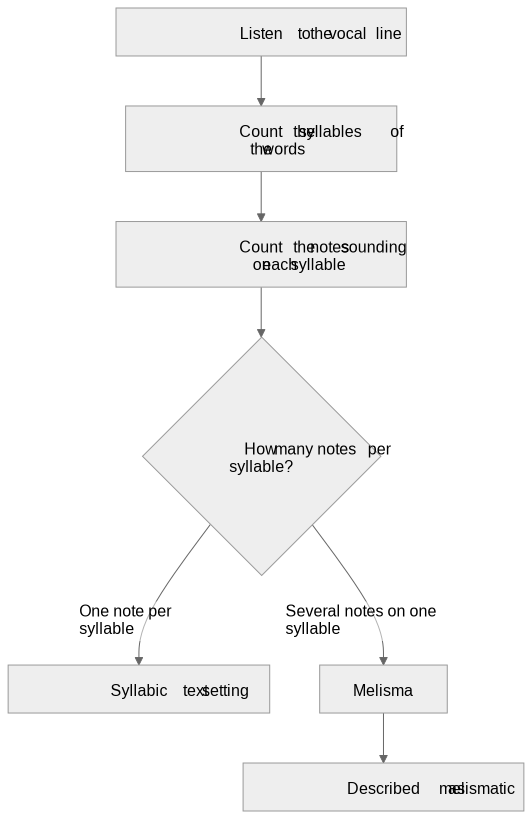
Think of a singer stretching a single vowel across several pitches: that one syllable carries a whole run of notes, and the device is a melisma, described as melismatic. The opposite habit gives each syllable exactly one note, which is syllabic writing. To identify either in a listening question, count the notes sounding against each syllable of the words: one note per syllable means syllabic, several notes on one syllable means melismatic. A useful method is to tap once per syllable while humming the melody; if your tapping and the tune's pitches no longer line up one-to-one, you are hearing a melisma. The terms describe text setting, not tempo, dynamics or texture, so keep them separate from performance markings.
What earns the marks
- Defines a melisma as several notes sung or played to a single syllable of text.
- Uses the adjective melismatic correctly when describing a melodic line or a passage.
- Defines syllabic text setting as one note per syllable.
- Distinguishes the two by counting notes against syllables rather than by loudness, speed or instrumentation.
- Applies the terms to a short musical excerpt, identifying which syllables are melismatic and which are syllabic.
Common mistakes and how to put them right
Confusing melisma with a trill or ornament.
Put it right: A melisma is defined by several notes on one syllable, whereas an ornament decorates a single note.
Calling a fast passage melismatic simply because it is quick.
Put it right: Speed is irrelevant, and the test is notes per syllable.
Assuming syllabic means unaccompanied or plain.
Put it right: Syllabic describes one note per syllable and can occur in any style or texture.
Exam tips
- When an excerpt is played, silently mouth the words and count syllables, then count the notes you hear on each one.
- Use the adjective form in your answer, for example describing a phrase as melismatic, to show precise vocabulary.
- If asked to compare two settings, state the note-to-syllable relationship for each rather than judging which sounds nicer.
Try the lesson
The start of the Appendix 3: Musical vocabulary - Dynamics and performance matters: A melisma is a group of notes used to set just one syllable of text. The adjective is ‘melismatic’. Where each syllable has one note, the style is ‘syllabic’ lesson, made from teaching notes for this specification point.
Have a go first
In vocal music, what is the term for a group of notes sung to a single syllable of text?
Listen
Think of a singer stretching a single vowel across several pitches: that one syllable carries a whole run of notes, and the device is a melisma, described as melismatic. The opposite habit gives each syllable exactly one note, which is syllabic writing. To identify either in a listening question, count the notes sounding against each syllable of the words: one note per syllable means syllabic, several notes on one syllable means melismatic. A useful method is to tap once per syllable while humming the melody; if your tapping and the tune's pitches no longer line up one-to-one, you are hearing a melisma. The terms describe text setting, not tempo, dynamics or texture, so keep them separate from performance markings. A strong answer earns marks for these points. Defines a melisma as several notes sung or played to a single syllable of text. Uses the adjective melismatic correctly when describing a melodic line or a passage. Defines syllabic text setting as one note per syllable. Distinguishes the two by counting notes against syllables rather than by loudness, speed or instrumentation. Exam tip: When an excerpt is played, silently mouth the words and count syllables, then count the notes you hear on each one.
See it
Key words
Say what each word means before you turn the card.
Melisma
Try answering aloud or in your head before turning the card.
Melismatic
Try answering aloud or in your head before turning the card.
Syllabic
Try answering aloud or in your head before turning the card.
Text setting
Try answering aloud or in your head before turning the card.
See every definition
- Melisma
- A group of notes used to set just one syllable of text.
- Melismatic
- The adjective describing a melodic line or passage in which several notes are used to set a single syllable of text.
- Syllabic
- The style of text setting where each syllable has one note.
- Text setting
- The relationship between notes and syllables of text, described as melismatic or syllabic, and separate from tempo, dynamics or texture.
There is more to this lesson
The full lesson goes on to check your understanding and help you earn the marks. Create a free account to carry on, with your progress saved.
A week of Premium from your first lesson · Then the free plan continues · No card, no charge
Test your understanding of Appendix 3: Musical vocabulary - Dynamics and performance matters: A melisma is a group of notes used to set just one syllable of text. The adjective is ‘melismatic’. Where each syllable has one note, the style is ‘syllabic’
Active recall beats re-reading. Take an instant quiz now to test what you’ve learned and lock it into long-term memory.
A week of Premium from your first lesson · Then the free plan continues · No card, no charge